Features
Discreet symptom tracking, day by day
A short email on the days you choose. About ten seconds to answer. Every day saved in order, ready for your next appointment.
How it works
- 1
Set up in two minutes.
A few questions about you, then how often we check in and when. Pain, bleeding and bowel movements are tracked from the start; add itching, discharge, swelling or anything else whenever you like.
- 2
Answer in about ten seconds.
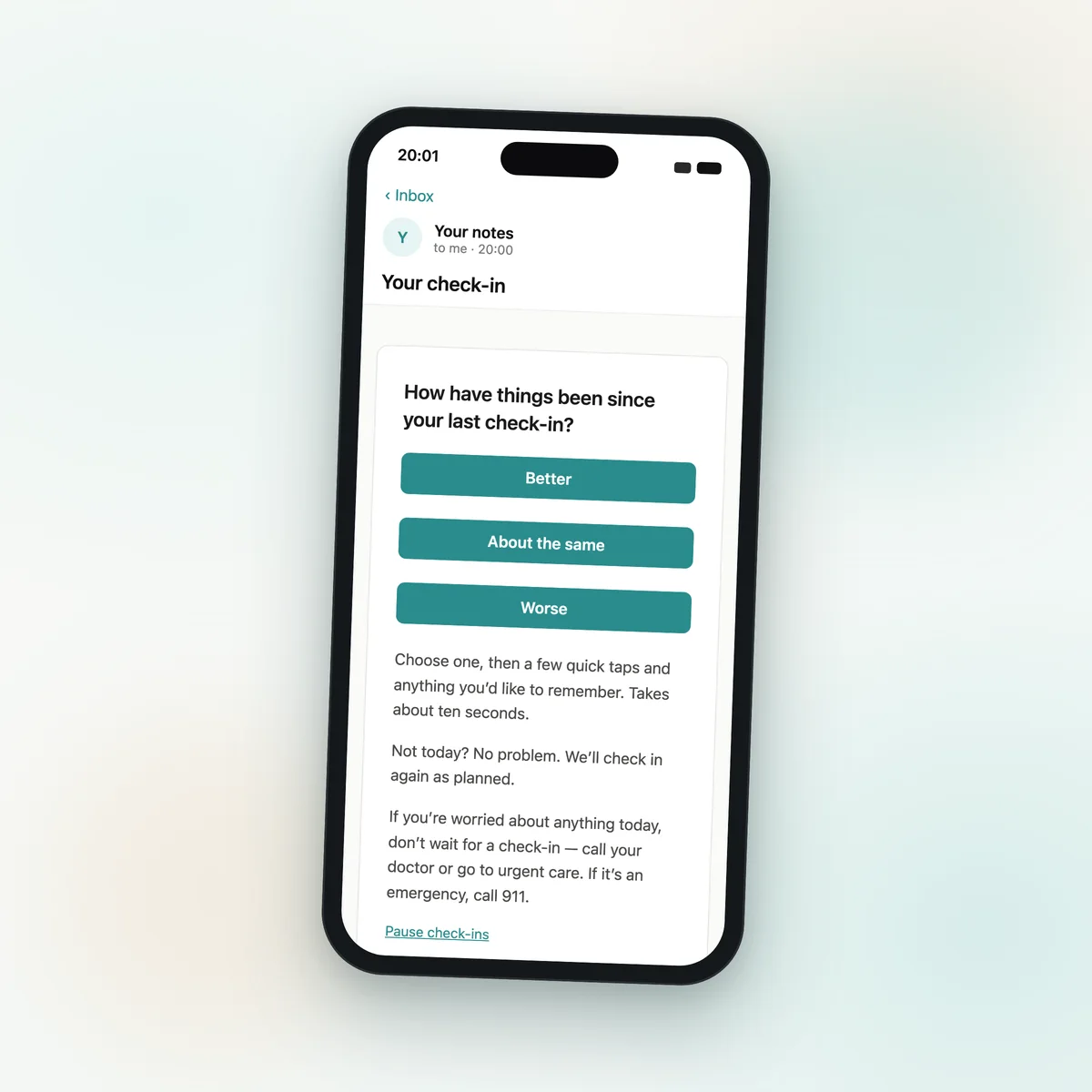
A plain email arrives. Choose better, about the same or worse, tap a level for each symptom, and add a note if you like: “first bowel movement since surgery”, “sore sitting at my desk”.
- 3
See your timeline.
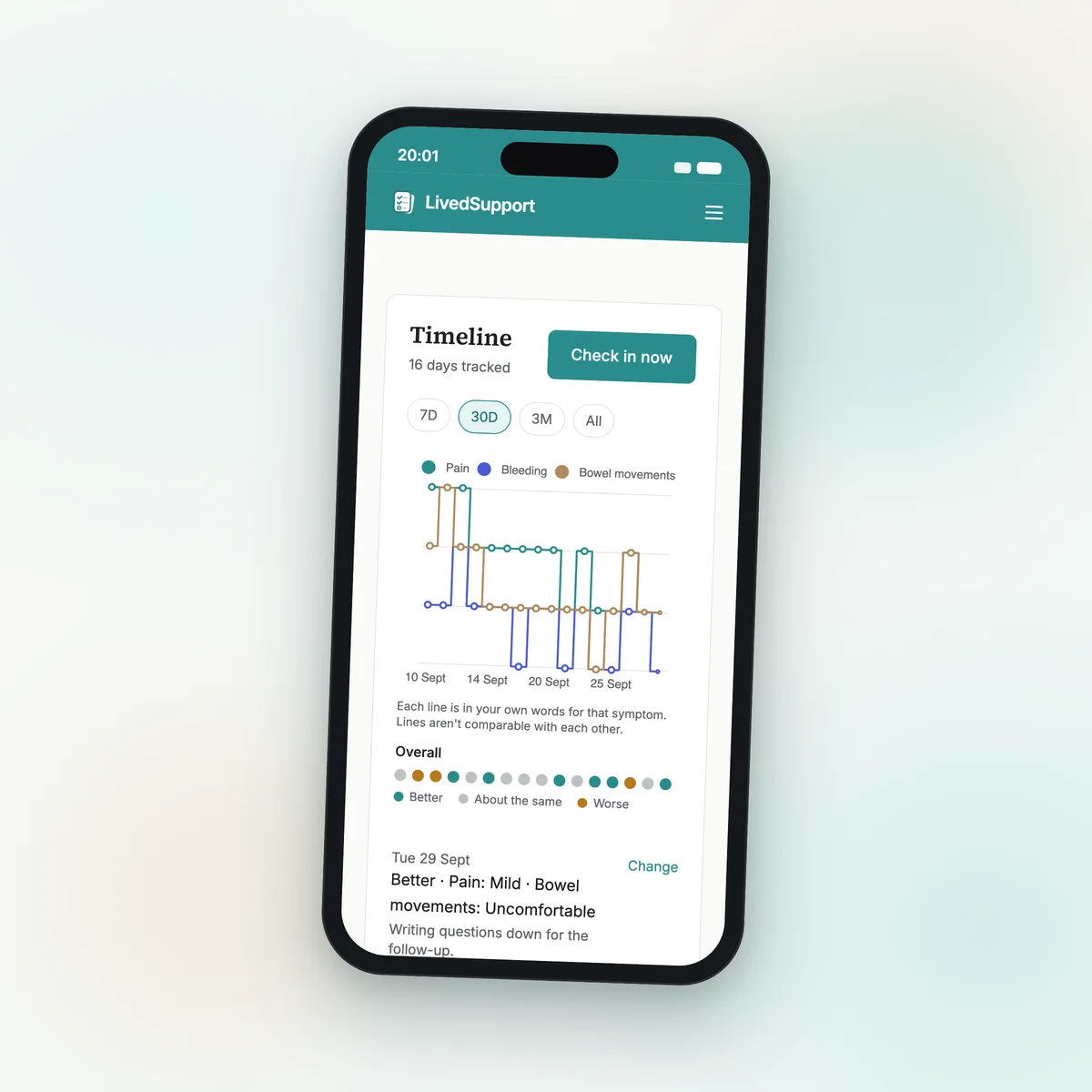
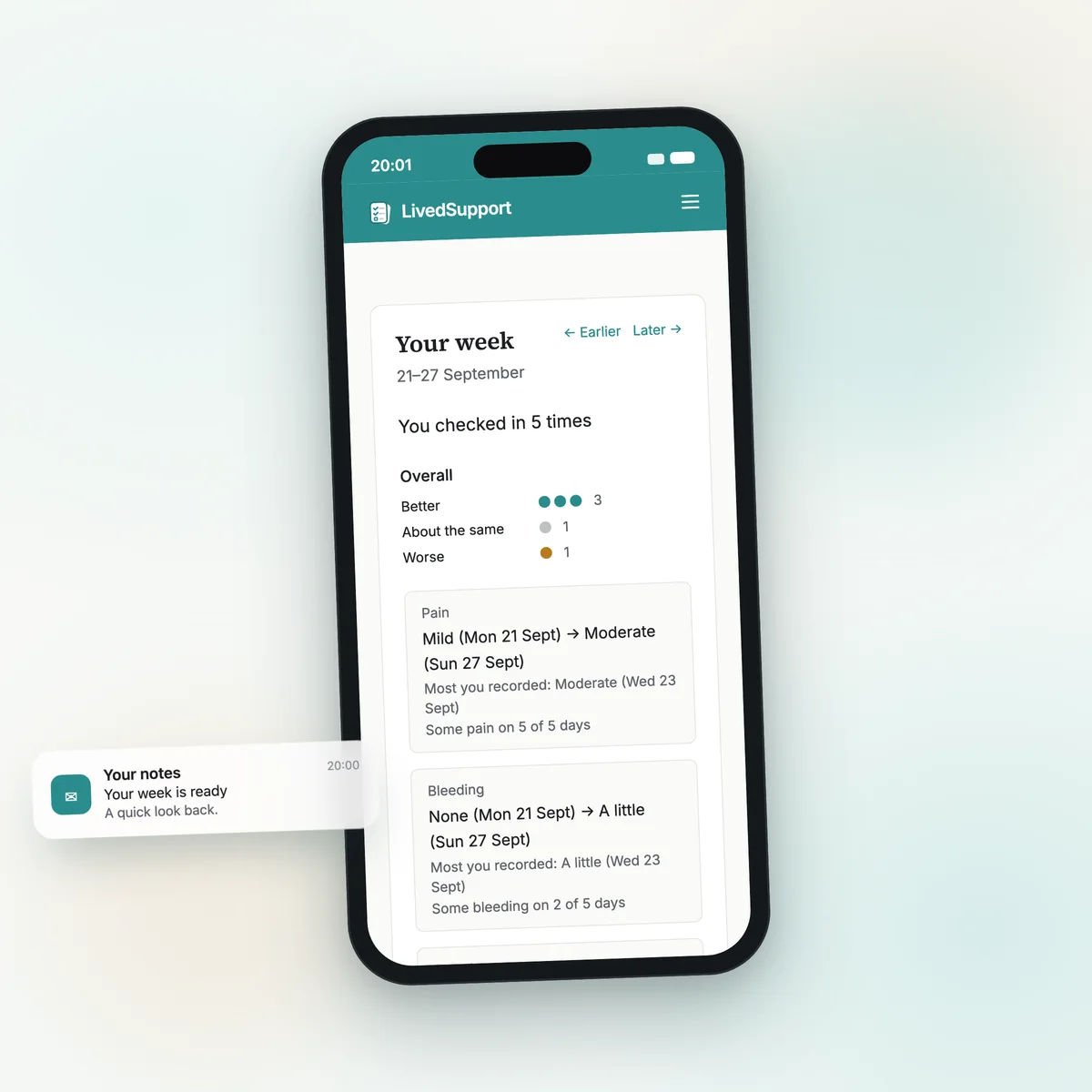
Every answer is saved in order, with the date. Each Sunday, we email you a link to your week, so “when did the bleeding change?” has an answer.
The email
Nothing on your lock screen gives it away.
It comes from “Your notes” with the subject “Your check-in”. No mention of your bottom, your surgery or what you’re tracking — safe to open at work, on the bus, or on a shared screen. Tap how things have been since last time, and you’re most of the way there.
Timeline
Every day, in order, in your own words.
Pain, bleeding, bowel movements — whatever you chose to track — laid out day after day, with the notes you wrote. The first bowel movement you dreaded. The week that felt stuck. The long drive that made it sore again. When someone asks “when did that start?”, you can look it up instead of guessing.
Your week, in your own words
A few weeks after a procedure, or when a fissure hurts after every bowel movement, the days run together. Was the bleeding worse on Tuesday or Thursday? When did the discharge change? Memory keeps the worst day and yesterday, and loses the rest.
Each Sunday, we email you a link to your week: which symptoms you marked, on how many days, the most you recorded, and the notes you wrote. We don’t score it, and we can’t tell you whether it’s normal for where you are. It’s your record to bring to someone who can: your colorectal surgeon or GI doctor, a nurse or your primary care doctor. Follow-up visits are short, and it’s easy to forget everything the moment you sit down.
What’s included
Made for hemorrhoids, fissures, fistulas and the weeks after surgery.
-
A check-in that looks like nothing
From “Your notes”, subject “Your check-in”, on the days and time you choose.
-
Ten seconds, your symptoms
Better, same or worse, then pain, bleeding, discharge or whatever you chose to track.
-
A timeline you can scroll back through
Your notes in date order, charted from your second check-in onward.
-
A Sunday look back
Your week, in your own words. No scores and no verdicts.
-
Days since surgery, counted for you
“Day 12 since your hemorrhoidectomy”, then a quiet email before your next appointment.
-
Pause, export or delete anytime
Away or feeling better? Pause check-ins. Download or delete everything whenever you like.
Every tracker page shows when to seek care, including when to call 911.
Start your record today.
Whether it’s day 3 after surgery or a flare that keeps coming back. Two minutes to set up, then your first check-in straight away. After that, emails arrive at the time you choose.
$7.99 a month or $69 a year
14-day refund. Cancel anytime. Delete your data whenever you like.
When to seek care Heavy bleeding or feeling faint? Get emergency help now. Emergency: 911
Not sure how urgent it is? Get help today.
- Emergency
Heavy bleeding, black tarry stools, feeling faint, severe pain or trouble breathing.
Call 911 or go to the ER.
- Today
Fever, pain getting worse, a hot swollen lump, or trouble passing urine.
Call your doctor or go to urgent care.
- Soon
Bleeding or bowel changes nobody has checked, or anything lasting 3 weeks.
Book a doctor’s appointment.
Feeling overwhelmed? Call or text 988, any time.
See all the signs
Recording how you feel is not the same as being checked. These are the signs that need a doctor’s attention.
Call 911 or go to the emergency room now if you have:
- bleeding that will not stop, a lot of blood (the toilet water turns red, or you pass large clots), or any bleeding with feeling faint or dizzy
- fainting, a racing heart or trouble breathing
- confusion or slurred speech, extreme shivering, no urine in a day, or blotchy skin
- sudden severe belly pain, or a swollen, hard belly with vomiting or not passing stool or gas
- you cannot pass urine at all, or your bladder feels full and painful and you can’t empty it
- redness, swelling or severe pain spreading quickly around your anus, genitals or groin, especially with a fever or feeling very ill
- a fever with a painful swelling near your anus if you have diabetes or a weakened immune system (for example, from chemotherapy or transplant medicines)
- black, tarry stools
Call your doctor or go to urgent care today (or the ER if you can’t be seen today) if you have:
- a temperature of 100.4°F (38°C) or higher, chills, vomiting, or feeling generally unwell
- pain that is getting worse over days, or severe pain that stops you sitting or sleeping
- a hot, swollen or very tender lump near your anus or at the top of the crease between your buttocks, or foul-smelling discharge
- trouble urinating
- bleeding that is getting heavier or more frequent, or blood mixed into your stool
- feeling much more tired than usual, looking pale, or getting out of breath more easily than you used to
- not passing stool for several days, or new belly pain
Make an appointment with your doctor if:
- you have never had these symptoms checked by a doctor or nurse — whatever your age
- you have had rectal bleeding for more than 3 weeks
- your bowel movements have been looser, thinner or more frequent than usual for 3 weeks or more, or you have lost weight without trying
- symptoms have not settled after a week or so, or keep coming back
- you notice a new lump near your anus, between your buttocks or in your belly, or an itch or discharge that does not clear
- you have new leakage or trouble controlling your bowels
- you are 45 or over, or have a family history of bowel cancer or inflammatory bowel disease, and any of these symptoms are new for you
If you are unsure, it is always reasonable to ask. If things feel overwhelming, call or text 988 (Suicide & Crisis Lifeline) or chat at 988lifeline.org, any time. If you don’t feel safe, call 911.
Showing US care routes. Change region at the foot of the page.